


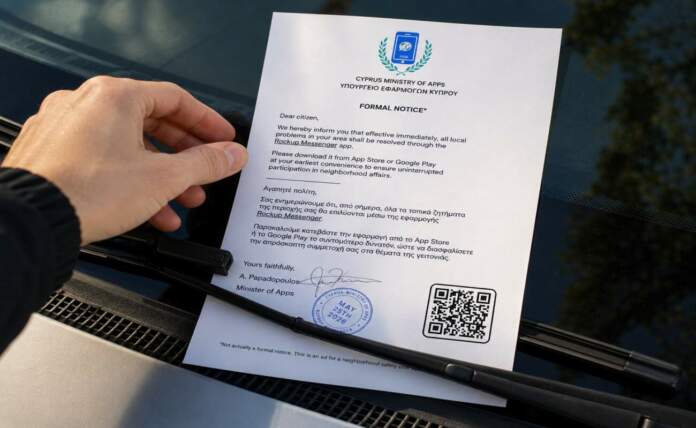
Earlier this year, residents across the city started finding handwritten notes in their letterboxes, on their cars, and in building entrances. Then came something else: official-looking leaflets, formatted like government notices. Spoiler alert — it was advertising.
The Campaigns
The handwritten notes were just one experiment in a longer series. Over the first half of 2026, the company tested multiple formats for reaching potential users in Limassol: standard digital advertising, flyers with QR codes, the personal-style handwritten notes, and materials designed to resemble official government notices.
On that last point, the company is direct: the government-style creatives were clearly marked as advertising due to the feedback from the previous tests. The format was designed to attract attention — and it did — but the materials themselves stated explicitly that they were not official notices.
“Whatever format we used, the goal was always the same — to tell people about Rockup. Every campaign was a test to find our voice. We accept that some formats generated more debate than we anticipated.” — Rockup Messenger
The government-style creative concept was designed to attract attention to a newly launched mobile app. The leaflets were clearly marked as advertising and deliberately used a humorous, fictional concept—”Ministry of Apps”—to spark curiosity and encourage people to discover the application.
Rockup is a neighbourhood messaging app that helps local communities connect and solve everyday local issues together. The campaign never requested payments or financial information, and its purpose was to promote community building—not to mislead or deceive the public.
The police were made aware of the company’s activities. It was investigated and found no evidence of criminal conduct.
How to Tell the Difference
The episode raised a legitimate question that extends well beyond Rockup: in an environment where phishing emails look like bank notifications and sponsored content is dressed as editorial, how does an ordinary person tell the difference between something genuine and something designed to deceive?
Digital literacy experts point to a consistent set of signals:
- Does it ask for personal data, payment, or login credentials upfront? Legitimate services rarely do.
- Can the company be found through independent sources — a registered business, a website, press coverage?
- Does the sender respond when contacted directly?
- Is there a privacy policy — and does it say anything intelligible?
- What does it actually ask the recipient to do — and who benefits?
By these measures, Rockup is traceable and verifiable. It is a registered Cyprus company. Its privacy policy is publicly available at rockup.com/privacy. Its team responds to direct contact. What it asks users to do is open an app and see who lives nearby.
What the App Actually Does
Rockup is a neighbourhood messaging app that connects users based on location rather than existing contacts. No phone number exchange required. No group invitation needed. A user opens the app and sees conversations happening nearby — on their street, in their building, across their district — in real time.
The company positions it primarily as a tool for practical local situations: a missing pet, a power outage, suspicious activity near a school.
Not everyone was convinced by the marketing. But some who downloaded the app despite their initial reservations found themselves reassessing.
“Anna doesn’t exist but whoever created this app it’s a good opportunity to create a friendly environment with your neighbors.” — Rockup user, posted in a neighbourhood chat
What remains is a question worth sitting with: in an era of phishing emails and fake notifications, how quickly do we reach for suspicion — and how often is that the right instinct?
Rockup is available at rockup.com. Media contact: [email protected]


